If you cannot listen to every call yourself, how do you know the AI is telling you the truth about what actually happened on it? The short answer is that Simple Intelligence proved accuracy through real business results: it has surfaced 35,000+ missed opportunities and $7M+ in potential revenue impact from call managers who would have never had time to review themselves.
Accuracy shows up in three main places: getting the words right, understanding what they mean for your business, and turning that understanding into suggestions. Here is how Simple Intelligence hits all three stages.
Getting the Words Right
Every AI call analytics platform starts by converting audio into text, including summary and transcription. Accuracy at this layer depends on call quality, accents, crosstalk, and industry-specific language. However, the transcription is important because it is what allows for the next steps to happen.
Understanding What Actually Matters to Your Business
Most call analytics tools score every business against the same metrics — a sentiment score and a talk time ratio — whether or not those numbers mean anything for how a business actually operates. Simple Intelligence works differently because it has Money Call Semantic: each business can define its own specific questions for the AI to answer on every call — “Was a competitor mentioned?” “Did they ask about pricing?” “Was a callback promised?”
Money Call Semantic is not just a customization feature but an accuracy advantage. A target yes/no question tied to a real decision is easier to get right and easier to double-check, rather than asking the AI to create a generic score. Instead of a report full of numbers, a manager gets answers to questions they believe are worth addressing and can then act on them.
Turning Understanding Into Recovered Revenue
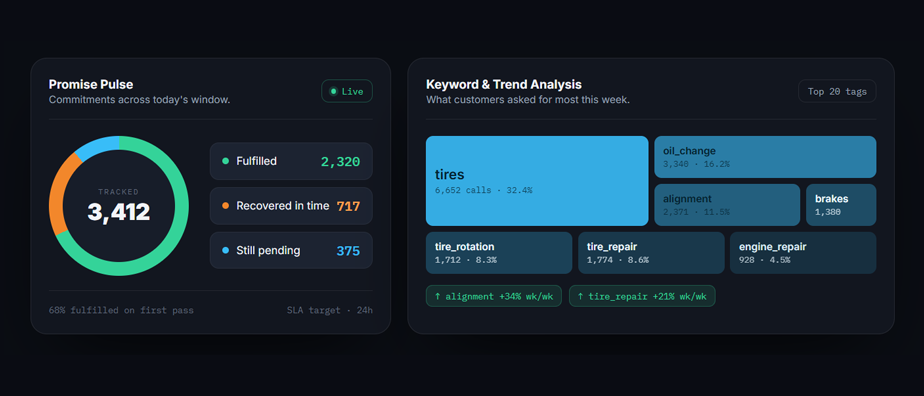
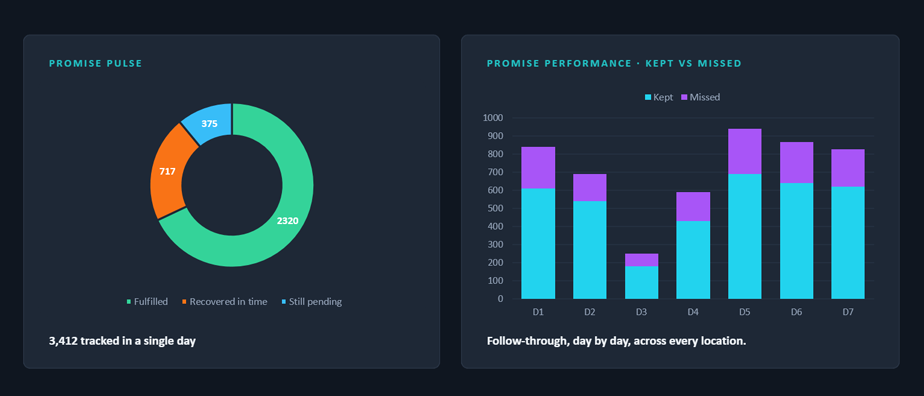
Promise Tracking is a key feature that improves accuracy within AI call analytics. When a rep tells a customer “I’ll call you back” or “I’ll send you a quote”, the Promise Tracking system detects the commitment, sets a timer, and flags it if it goes unfulfilled. Without this system, many customers quietly stop calling back without being caught,
Missed Opportunity Alerts and Lost Call Rescue are also important features for accuracy. Instead of just noting that a call ends without a sale, the system identifies the ones where real interest was shown and triggers re-engagement, giving the team a second chance at a deal.
Proof of Accuracy at Scale
- Simple Intelligence analyzes 250,000+ customer calls every week
- Out of that volume, it has identified 35,000+ missed opportunities
- Out of those opportunities, it has translated into $7M+ in potential revenue impact uncovered — a 14% opportunity identification rate that remains steady across multi-location enterprises in automotive, retail, and restaurants
- Roughly 1 in 7 calls contain a detail such as a buying signal, a broken promise, or an unassigned follow-up that would otherwise go unnoticed
Human Aspect Of Simple Intelligence
With Coaching Insights, accuracy is further improved as AI can identify call patterns, tone issues, and missed questions, then use real calls, both good and bad, to create coaching packs. The packages are targeted for the team, rather than requiring a manager to look through recordings to build them manually. In combination with Missed Opportunity Alerts and Promise Tracking, the Coaching Insights system is able to pull from company- specific insights to choose the right moments to teach from.
Accuracy is important because it recovers revenue, trust, and coaching time that would otherwise be lost in recordings no one has time to listen to.
The best way to judge accuracy is against your own calls. Book a demo, and we will show you what Simple Intelligence would have caught on your team’s calls.